

A Holistic Psychological Approach to Mind-Body Wellbeing
Your body communicates what your mind and emotions may not always express. You may notice that your heart races when you are anxious, your breathing changes when you are overwhelmed, your muscles tighten when you are under pressure, or you find it difficult to relax even when you know you need to. This is why we offer Biofeedback training in Lagos.
Sometimes, the challenge is not simply knowing that you are stressed.
It is learning to recognise how stress affects your whole system and what you can do about it.
At 360 Psyche, biofeedback training is approached as part of a broader holistic psychological and wellbeing process. Rather than focusing only on physiological measurements, the approach considers the relationship between your thoughts, emotions, body, behaviour, relationships, environment and lifestyle.
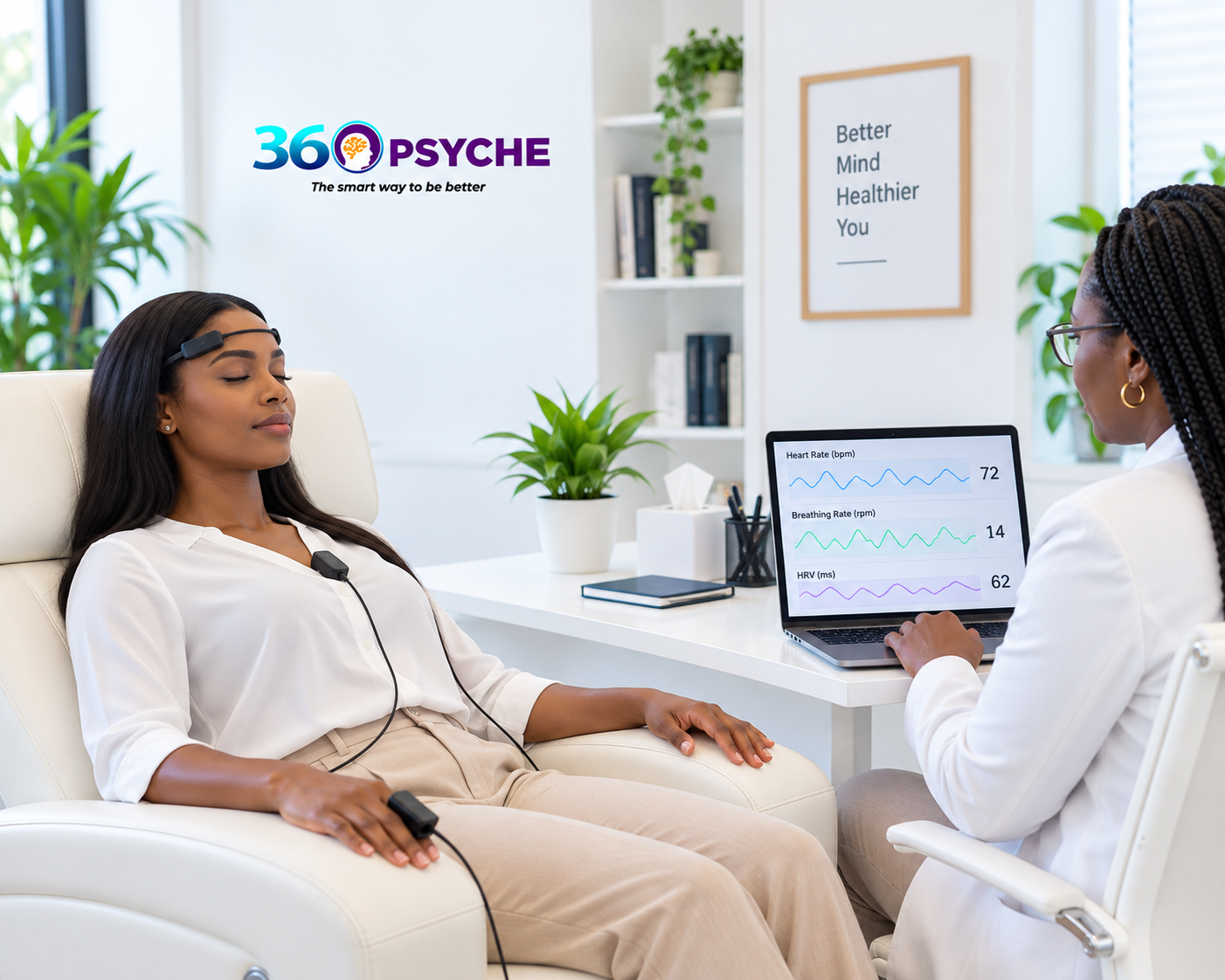
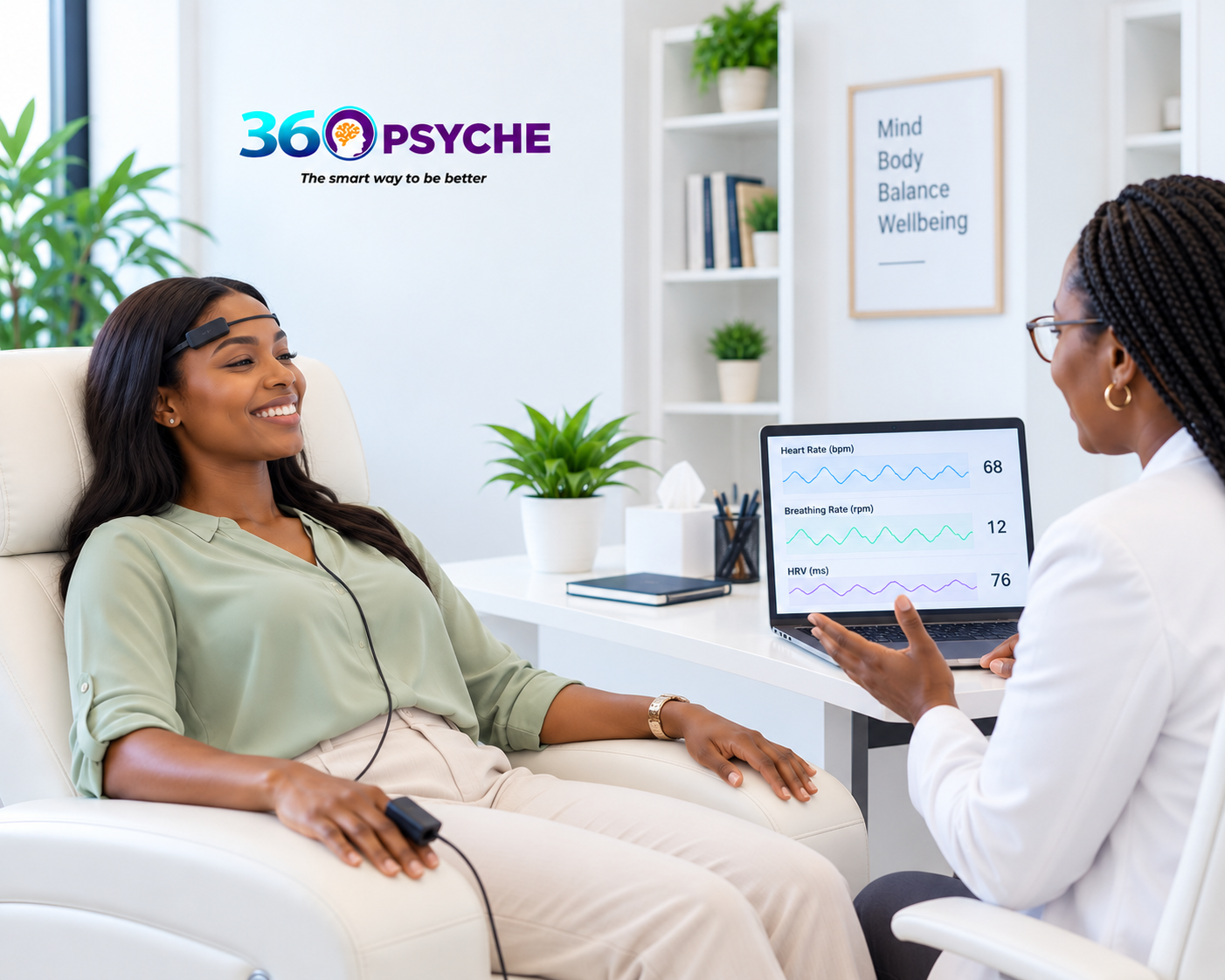
Biofeedback can provide real-time information about selected physiological responses, helping you develop greater awareness of how your body responds to stress and how relaxation and self-regulation techniques may influence those responses.
The aim is not simply to make a number on a screen change.
The aim is to help you understand yourself better, develop practical self-regulation skills and support healthier physiological and psychological functioning in everyday life.
Face-to-face psychological services are available in Lagos, with online services available for clients across Nigeria and internationally.
Book a confidential consultation to explore whether biofeedback training is appropriate for you.
What Is Biofeedback?
Biofeedback is a training approach that provides information about physiological processes that normally happen automatically.
Depending on the type of biofeedback being used, sensors may monitor physiological signals such as:
- Heart rate
- Heart-rate variability
- Breathing patterns
- Muscle activity
- Skin temperature
- Other physiological responses
The information is presented in real time, allowing you to observe changes while practising specific techniques.
This creates an opportunity to understand the connection between:
Thoughts → emotions → physiological responses → behaviour
and, importantly:
Awareness → regulation → healthier responses
For example, when you experience stress, your thoughts may become more rapid, your breathing may change, your muscles may tense and your heart rate may increase.
Biofeedback can help make some of these physiological changes more visible.
With professional guidance and repeated practice, you can learn to recognise your body’s signals and practise appropriate strategies for regulating your responses.
However, at 360 Psyche, biofeedback is not viewed as a machine-based solution to psychological problems.
It is one tool within a holistic psychological approach.
Our Holistic Psychological Approach to Biofeedback
At 360 Psyche, psychological wellbeing is understood as more than the absence of mental illness.
Your psychological functioning can be influenced by many interconnected factors.
These may include:
Your thoughts
How you interpret situations, perceive threats, think about yourself and anticipate the future can influence how you respond emotionally and physically.
Your emotions
Anxiety, anger, sadness, fear, frustration and other emotions can produce noticeable physiological responses.
Your body
Sleep, breathing, muscle tension, heart-rate patterns, fatigue and other physical experiences can interact with your psychological state.
Your behaviour
Avoidance, withdrawal, overworking, excessive reassurance-seeking, unhealthy coping strategies or difficulty setting boundaries can contribute to ongoing stress.
Your relationships
Family relationships, intimate relationships, friendships, workplace interactions and social support can influence emotional wellbeing.
Your environment
Work demands, financial pressures, family responsibilities, social expectations and other environmental factors can affect stress levels.
Your lifestyle
Sleep, exercise, rest, nutrition, workload, technology use and opportunities for recovery can all form part of the broader picture.
This is why our approach does not ask only:
- “What is happening with your heart rate?”
We also ask:
- “What is happening in your life?”
- “What are you thinking and feeling?”
- “How are you responding?”
- “What patterns may be maintaining your stress?”
- “What resources and strengths do you already have?”
- “What changes could support your overall wellbeing?”
Biofeedback can then become part of a more meaningful psychological intervention rather than an isolated technological experience.
Biofeedback and the Mind-Body Connection
The mind and body are not separate systems operating independently.
Psychological experiences can influence physiological responses, while physical states can influence how we think, feel and behave.
Consider what happens when you receive frightening or stressful news.
You may immediately experience:
- Increased heart rate
- Faster breathing
- Muscle tension
- Sweating
- Restlessness
- Difficulty concentrating
- A sense of urgency
The physiological response can happen very quickly.
Similarly, prolonged stress may leave you feeling physically exhausted while your mind remains active.
You may think:
“I am tired, but I cannot switch off.”
This is where understanding the mind-body relationship can become valuable.
Biofeedback can help you observe selected physiological responses while psychological techniques help you explore the thoughts, emotions, behaviours and circumstances associated with those responses.
Together, these approaches can provide a more complete picture.
Biofeedback Training for Stress Management in Lagos
Stress is a normal part of life.
Work, relationships, parenting, business, academic demands, financial responsibilities, health concerns and major life changes can all create pressure.
The problem may arise when stress becomes prolonged, overwhelming or difficult to regulate.
You may find yourself:
- Constantly tense
- Easily irritated
- Mentally exhausted
- Unable to relax
- Sleeping poorly
- Overthinking
- Struggling to concentrate
- Feeling overwhelmed by ordinary responsibilities
- Experiencing physical symptoms during stressful situations
- Finding it difficult to switch off after work
Biofeedback training can help you become more aware of your physiological responses to stress and practise techniques designed to support regulation.
But our holistic psychological approach goes further.
Rather than simply teaching you how to “calm your body,” the therapeutic process can also explore:
- What is creating the stress?
- How are you interpreting stressful situations?
- What coping strategies are you currently using?
- Are you overextending yourself?
- Are boundaries contributing to your stress?
- Are relationship dynamics affecting your wellbeing?
- Is your lifestyle allowing enough recovery?
- Are there psychological patterns maintaining the problem?
This distinction is important.
Managing the physiological response is valuable, but understanding the wider context can help you address the factors contributing to that response.
Biofeedback for Anxiety Management
Anxiety is experienced differently by different people.
For some, it is primarily racing thoughts and excessive worry.
For others, it may feel like a physical experience:
- “My heart is racing.”
- “I cannot catch my breath.”
- “My chest feels tight.”
- “I cannot sit still.”
- “My whole body feels tense.”
- “I feel like something terrible is about to happen.”
Anxiety can involve thoughts, emotions, physical sensations and behaviours.
A holistic psychological approach therefore looks at the entire pattern rather than focusing on only one symptom.
Biofeedback may help you develop greater awareness of physiological activation while psychological intervention can address the thoughts, interpretations, behaviours and circumstances associated with anxiety.
Depending on your needs, your psychological care may incorporate approaches such as:
- Psychoeducation
- Relaxation training
- Breathing techniques
- Cognitive strategies
- Behavioural strategies
- Emotional regulation
- Stress-management skills
- Lifestyle considerations
- Relationship and environmental factors
Biofeedback can complement these approaches where clinically appropriate.
Biofeedback and Emotional Regulation
Strong emotions are not necessarily unhealthy.
Anger, fear, sadness, frustration and excitement are all part of normal human experience.
The difficulty can arise when emotional responses become overwhelming, prolonged or difficult to manage.
For example, you may notice that before becoming extremely angry:
- Your heart begins racing
- Your breathing changes
- Your jaw tightens
- Your shoulders tense
- Your body becomes hot
- Your thoughts become faster
- You become more reactive
Recognising these early signals can create an opportunity to intervene before the emotional response escalates.
Biofeedback training in Lagos can support this awareness by helping you observe physiological responses in real time.
Psychological work can then help you understand:
- What triggered the emotion?
- What meaning did you attach to the situation?
- What were you thinking?
- What did you do next?
- What could you do differently next time?
This is the essence of holistic psychological care.
The objective is not to eliminate emotions.
It is to develop a healthier relationship with them.


What Happens During Biofeedback Training?
Your programme is individualised according to your concerns, goals and assessment.
1. Initial Psychological Consultation
Your first session provides an opportunity to understand why you are seeking support.
The therapist may explore:
- Your current concerns
- Emotional experiences
- Stressors
- Anxiety symptoms
- Physical experiences
- Sleep
- Work and lifestyle
- Relationships
- Coping strategies
- Previous treatment
- Your goals
The purpose is to understand the whole person rather than a single symptom.
2. Understanding Your Mind-Body Patterns
You may be guided to identify relationships between your psychological experiences and physiological responses.
For example:
Trigger → Thought → Emotion → Body Response → Behaviour
Understanding this sequence can help you recognise patterns that previously felt automatic.
3. Physiological Feedback
Appropriate sensors may be used to monitor selected physiological responses.
You can then receive feedback while practising specific regulation techniques.
This provides an opportunity to observe how your physiological state changes.
4. Psychological Skills Training
Depending on your needs, training may incorporate appropriate techniques such as:
- Controlled breathing
- Relaxation
- Mindful awareness
- Emotional regulation
- Stress-management strategies
- Cognitive strategies
- Behavioural strategies
The emphasis is on learning skills that can eventually be applied in everyday situations.
5. Personalised Integration
Your therapist can help connect what you learn during biofeedback to your everyday life.
For example:
- What happens when you are under pressure at work?
- What happens during conflict?
- What happens when you feel criticised?
- What happens when you are overwhelmed?
- What happens when you do not get enough sleep?
The aim is to move from simply observing physiological responses to understanding and managing the broader pattern.
Biofeedback Is About Learning, Not Perfection
One misconception about biofeedback is that the objective is to remain calm all the time.
That is not realistic.
Stress is part of life.
Emotions are part of life.
Physiological activation is part of being human.
The goal is not to eliminate normal responses.
The goal is to become more aware of them and develop healthier ways of responding.
You may eventually become better able to recognise:
- “I am becoming overwhelmed.”
- “My body is becoming tense.”
- “My breathing has changed.”
- “I need to pause.”
- “I know what I can do to regulate myself.”
This awareness can become an important part of psychological resilience.
Who May Benefit From Holistic Biofeedback Training?
Biofeedback may be considered for individuals experiencing:
- Stress
- Anxiety
- Emotional overwhelm
- Difficulty relaxing
- Physiological tension
- Difficulty recognising stress signals
- Work-related stress
- Performance pressure
- Emotional reactivity
- Difficulty regulating emotions
- Chronic feelings of being “on edge”
- Problems with relaxation
- ADHD need areas
- High-pressure professional demands
It may also be appropriate for people who simply want to develop greater self-awareness and stress-management skills.
However, biofeedback is not automatically appropriate for everyone.
A professional assessment helps determine whether it fits your needs and whether another form of psychological or medical support would be more appropriate.
Who Is Biofeedback Training Suitable For?
Biofeedback may be useful for:
Adults
Individuals seeking support with stress, anxiety, emotional regulation or wellbeing.
Professionals and Executives
People working in demanding or high-pressure environments who want to develop healthier stress-management and self-regulation skills.
Students
Students experiencing academic pressure, examination stress or difficulty managing competing demands.
Individuals in Therapy
People already receiving psychological treatment who may benefit from adding physiological awareness and regulation skills to their existing intervention.
Organisations
Companies seeking structured approaches to employee wellbeing, stress management and psychological health.
The specific approach should always be tailored to the individual or organisation.
Biofeedback and Psychological Therapy
Biofeedback does not have to exist separately from psychotherapy.
In appropriate circumstances, the two can complement each other.
Psychotherapy may help you explore:
- Why am I responding this way?
- What experiences shaped this pattern?
- What thoughts maintain my anxiety?
- How do my relationships affect my emotional wellbeing?
- What behaviours are helping or hurting me?
Biofeedback may help you explore:
- What happens in my body when this occurs?
- Can I recognise physiological activation earlier?
- What happens when I regulate my breathing?
- What techniques help me settle?
Together, these perspectives can create a broader understanding of psychological functioning.
A Whole-Person Approach to Mental Wellbeing
At 360 Psyche, the philosophy behind holistic psychological care is simple:
You are more than a diagnosis.
You are a whole person with experiences, relationships, responsibilities, strengths, challenges, beliefs, habits, emotions and aspirations.
Two people may experience anxiety but have completely different reasons for experiencing it.
One person may be struggling because of workplace pressure.
Another may be dealing with relationship difficulties.
Another may be experiencing grief.
Another may have developed longstanding patterns of worry.
Another may simply be overwhelmed by multiple responsibilities.
The physiological response may look similar.
The person behind the response is different.
That is why our approach begins with understanding the individual.
Why Choose 360 Psyche for Biofeedback Training in Lagos?
At 360 Psyche, biofeedback is integrated into a broader psychological framework rather than offered as a one-size-fits-all technological intervention.
Our approach emphasises:
Professional Psychological Understanding
Your physiological responses are considered alongside your psychological experiences.
Individualised Care
Your goals, concerns and circumstances inform the intervention.
Mind-Body Integration
The relationship between psychological and physiological functioning is considered as part of your care.
Practical Skills
The focus is on developing skills that you can use beyond the session.
Holistic Wellbeing
Where appropriate, psychological, behavioural, lifestyle and relational factors may be considered.
Confidentiality and Professional Care
Your wellbeing, privacy and dignity remain central to the therapeutic process.
Biofeedback in Lagos for Modern Stress
Life in Lagos can be fast-paced and demanding.
Long working hours, traffic, business pressures, family responsibilities, financial demands, social expectations and constant digital connectivity can create an environment where switching off becomes difficult.
You may be physically at home while mentally still at work.
You may be exhausted but unable to sleep.
You may have time to rest but struggle to actually relax.
You may notice that you are becoming increasingly reactive, anxious or emotionally drained.
This is where learning to understand your stress response can be valuable.
Biofeedback training can provide a structured opportunity to slow down, observe what is happening in your body and practise healthier regulation strategies.
But holistic psychological care asks an additional question:
What needs to change beyond the session?
Sometimes, the answer involves coping skills.
Sometimes, it involves boundaries.
Sometimes, it involves relationships.
Sometimes, it involves workload.
Sometimes, it involves unresolved emotional experiences.
Sometimes, it involves psychological treatment.
And sometimes, it involves a combination of several factors.
Biofeedback Near Me in Lagos
If you are searching online for:
“Biofeedback near me”
“Biofeedback therapy near me”
“Biofeedback training Lagos”
“HRV biofeedback Lagos”
“Biofeedback psychologist Lagos”
“Stress management Lagos”
or
“Holistic mental health services Lagos”
the most important consideration is not simply whether a provider has biofeedback equipment.
Consider whether the service also provides professional psychological assessment and understands the wider context of your wellbeing.
360 Psyche provides face-to-face psychological services in Lagos and online psychological services for clients in Nigeria and internationally.
Our Lagos services are available at Ikota, Ajah, making professional psychological support accessible to individuals seeking confidential care within Lagos.
What Makes Our Approach Different?
Technology can show you what your body is doing.
Psychological care helps you understand why.
Training helps you learn what you can do differently.
That is the philosophy behind our holistic approach.
Biofeedback can provide information.
Psychological assessment provides context.
Therapy provides understanding.
Skills training provides practical tools.
Lifestyle and behavioural changes can support long-term wellbeing.
Together, these elements can create a more comprehensive approach to psychological health.
Frequently Asked Questions About Biofeedback Training
What is biofeedback training?
Biofeedback training is a process that provides real-time information about selected physiological responses, helping individuals develop greater awareness and practise self-regulation techniques.
Is biofeedback available in Lagos?
Yes. 360 Psyche provides biofeedback-related psychological services in Lagos as part of its broader mental health and wellbeing services.
Does biofeedback help with anxiety?
Research suggests that certain forms of biofeedback, including HRV biofeedback, may help with stress and anxiety. However, results vary, and biofeedback should be viewed as a component of appropriate care rather than a guaranteed cure.
Can biofeedback help with stress?
Biofeedback may help you recognise physiological stress responses and practise techniques designed to support relaxation and self-regulation.
What is holistic biofeedback?
Holistic biofeedback refers to an approach that considers physiological feedback within the broader context of a person’s psychological, emotional, behavioural, relational and lifestyle wellbeing.
Is biofeedback the same as neurofeedback?
No. Biofeedback is a broader category involving feedback about physiological processes. Neurofeedback is a specific form of biofeedback involving brain activity.
Do I need a diagnosis for biofeedback?
Not necessarily. Some people seek biofeedback to develop stress-management, relaxation and self-regulation skills without having a diagnosed psychological disorder.
Can biofeedback replace psychotherapy?
No. Biofeedback and psychotherapy serve different purposes. They may sometimes be used together when clinically appropriate.
How many biofeedback sessions will I need?
There is no universal number. Your needs, goals, response to training and overall psychological care plan will influence the recommended duration.
Can biofeedback be used alongside therapy?
Yes. Where appropriate, biofeedback may complement psychotherapy by providing additional opportunities to develop physiological awareness and regulation skills.
Is biofeedback suitable for everyone?
No intervention is suitable for everyone. An assessment can help determine whether biofeedback is appropriate for your circumstances.
Begin Your Biofeedback Journey in Lagos, Nigeria
You do not have to wait until stress becomes overwhelming before learning more about your mind-body responses.
If you have been feeling tense, anxious, overwhelmed, emotionally reactive or unable to relax, professional support can help you understand what may be happening.
Biofeedback training at 360 Psyche combines physiological awareness with a holistic psychological perspective.
Rather than focusing only on symptoms, the approach considers the person as a whole.
Your:
- Mind.
- Body.
- Emotions.
- Behaviour.
- Relationships.
- Environment.
- Lifestyle.
- And overall psychological wellbeing.
The objective is not simply to help you feel calmer for one session.
It is to help you develop greater self-awareness and practical skills that can support healthier responses to stress and emotional challenges in everyday life.
Book a Confidential Consultation
360 Psyche – Holistic Psychological Care
Face-to-Face Services: Ikota, Ajah, Lagos
Online Services: Online Biofeedback Training — Professional Guidance From Anywhere
Phone / WhatsApp: +234 809 664 2604 | +234 901 241 0880
Email: gethelp @ 360psyche.com
If you are unsure whether biofeedback is right for you, you do not need to make that decision alone.
Start with a confidential consultation.
A psychological professional can help you understand your concerns and determine whether biofeedback, psychotherapy, another intervention or a combination of approaches may best support your needs.
Understand your body. Understand your mind. Develop healthier ways to respond.
Book your biofeedback consultation with 360 Psyche today.
Biofeedback is generally a safe form of therapy. You can send us a message for additional information. Learn more about who we are and what we do.