

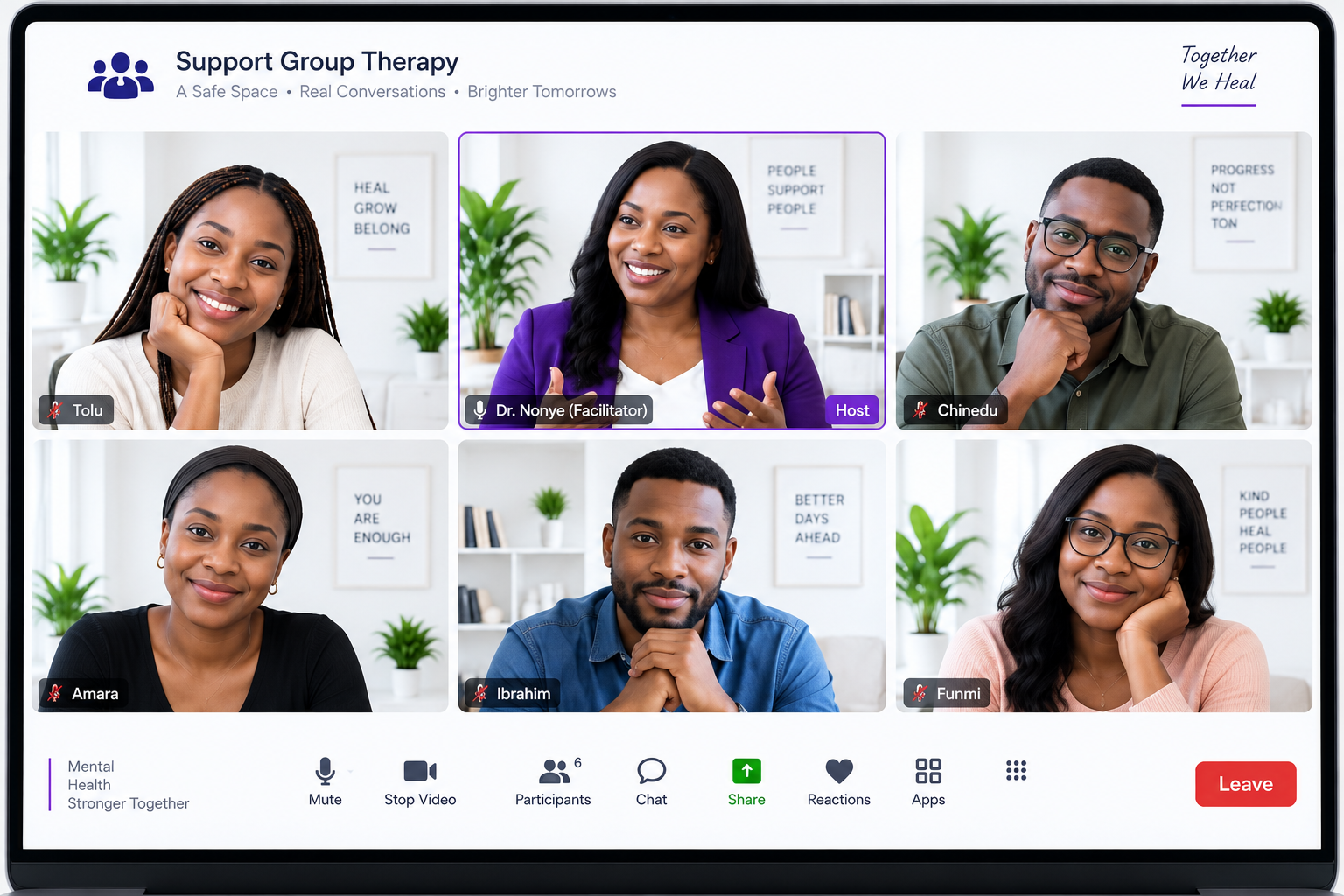


Heal, Connect, Grow Together
Sometimes, knowing that you are not the only person going through something can make a meaningful difference.
At 360 Psyche, our group therapy and support groups provide a structured, confidential, and supportive space where people with shared experiences or similar mental health needs can connect, learn, receive professional guidance, and work toward positive change.
Trained mental health professionals facilitate our group therapy in Nigeria and can support people experiencing challenges such as anxiety, depression, stress, trauma, relationship difficulties, grief, loneliness, addiction recovery and other emotional or behavioural concerns.
Whether you are looking for group therapy in Lagos, Abuja or Port Harcourt, or prefer online group therapy from anywhere in Nigeria or abroad, 360 Psyche provides professionally guided psychological support designed around your needs.
You do not have to navigate everything alone.

What Is Group Therapy?
Group therapy is a form of psychotherapy in which a trained mental health professional works with several participants who may be experiencing similar psychological, emotional, behavioural or life challenges.
Unlike an informal conversation among friends, group therapy has a therapeutic structure. A trained therapist facilitates the sessions, establishes boundaries, guides discussions and helps participants develop healthier ways of understanding and responding to their experiences.
Group therapy may involve:
- Guided therapeutic discussions
- Psychoeducation
- Emotional support
- Cognitive and behavioural strategies
- Communication exercises
- Coping skills
- Problem-solving
- Relationship skills
- Emotional regulation
- Reflection and self-awareness
- Practical therapeutic exercises
- Peer learning and shared experiences
At 360 Psyche, participants are not simply placed into a group because they have requested group therapy. An initial assessment helps us understand your needs and determine whether group therapy is appropriate and which type of group may be most suitable.
This approach helps us create groups that are purposeful, supportive and clinically appropriate.
Group Therapy vs. Support Groups
The terms group therapy and support group are sometimes used interchangeably, but they are not always the same.
Group therapy is a structured psychological intervention facilitated by a trained mental health professional. It is usually designed around specific therapeutic goals and may focus on emotional regulation, coping, interpersonal relationships, behavioural change or a particular mental health concern.
A support group generally focuses more strongly on shared experiences, connection, encouragement and mutual support. Depending on the group, it may or may not be facilitated by a mental health professional.
At 360 Psyche, our support-oriented groups may incorporate professional psychological guidance, psychoeducation and structured discussions. Where a participant requires individualised assessment or treatment, we may recommend individual therapy or another appropriate clinical service.
This distinction matters because the right type of support depends on what you are experiencing and what you need at the time.
Who Can Benefit From Group Therapy?
Group therapy can be helpful for adults who want professional support while also benefiting from the experiences and perspectives of others.
You may consider group therapy if you are experiencing:
Anxiety and Excessive Worry
Anxiety can affect concentration, relationships, sleep, work and everyday functioning. A structured anxiety therapy group can provide opportunities to learn practical coping strategies while hearing from others who understand similar experiences.
Depression and Low Mood
Depression can create isolation and make it difficult to explain what you are experiencing to others. A professionally facilitated group can provide connection, psychoeducation, coping strategies and a supportive environment.
Stress and Emotional Overload
Work pressure, family responsibilities, financial concerns, relationship difficulties and major life changes can contribute to prolonged stress. Group sessions can help participants understand their responses to stress and develop healthier coping strategies.
Trauma and Difficult Life Experiences
Some people find it helpful to connect with others who have experienced trauma or significant life difficulties. Trauma-focused groups require appropriate screening and should be facilitated within a clinically safe framework.
Breakups, Separation and Divorce
Relationship loss can affect identity, self-esteem, mood and everyday functioning. A breakup, separation or divorce support group can provide a structured space to process emotions and develop healthier coping strategies.
Grief and Loss
Grief can be complicated and deeply personal. Sharing experiences with others who are navigating loss may reduce feelings of isolation while providing opportunities to learn about healthy coping and adjustment.
Relationship Difficulties
Group therapy can provide an opportunity to learn about communication, boundaries, emotional regulation, conflict management and interpersonal patterns.
Loneliness and Social Isolation
For people who feel disconnected from others, a carefully structured group can provide opportunities to practise communication, build social confidence and experience healthy connection.
Addiction Recovery
Group-based psychological support can complement addiction recovery by providing accountability, psychoeducation, coping strategies and connection. Where addiction involves significant clinical or medical needs, additional specialist treatment or psychiatric support may be recommended.
Personal Growth and Emotional Wellness
Not every group has to centre around a diagnosis. Some groups may focus on emotional wellness, self-awareness, resilience, coping skills, relationships and personal development.
Why Choose Group Therapy?
One of the unique features of group therapy is the opportunity to receive professional guidance while learning from other people’s experiences.
1. You Realize You Are Not Alone
Mental health challenges can feel extremely isolating. Listening to people describe experiences that resemble your own can help reduce the sense that you are the only person struggling.
2. You Gain Different Perspectives
Every participant brings a different background, personality and way of approaching problems. Hearing different perspectives can help you consider situations from new angles.
3. You Learn Through Shared Experiences
Participants can learn practical coping strategies from one another while receiving professional guidance from the therapist.
4. You Can Practice Communication
A therapy group provides an opportunity to practice expressing thoughts, listening, setting boundaries and responding to others in a structured environment.
5. You Can Develop Greater Self-Awareness
Group interactions can help you notice patterns in how you communicate, respond to conflict, seek reassurance, withdraw or relate to other people.
6. You Receive Professional Guidance
Our groups are not simply social gatherings. Depending on the programme, sessions may include therapeutic exercises, psychoeducation, guided reflection and practical strategies.
7. It Can Be More Accessible
Group therapy can sometimes provide access to professional psychological support at a lower cost than individual therapy, depending on the programme and number of participants.
8. You Can Build a Sense of Connection
A safe therapeutic group can create an environment where participants feel heard, respected and understood.
Research and clinical practice support the use of group-based psychological interventions for a range of mental health and behavioural concerns, although suitability depends on the individual’s needs, the type of group and the quality of facilitation.
Our Group Therapy Approach at 360 Psyche
At 360 Psyche, we believe group therapy should be intentional, professionally guided and personalised.
We do not believe that putting everyone with a similar diagnosis or problem into one room automatically creates an effective therapeutic group.
Instead, we consider factors such as:
- Your presenting concerns
- Your therapeutic goals
- Your current level of psychological distress
- Your ability to participate in a group setting
- The type of group available
- Group composition
- Your personal preferences
- Whether individual therapy may be more appropriate
- Whether additional psychiatric or specialist support is required
This assessment-led approach helps us determine the most appropriate pathway for you.
How 360 Psyche Group Therapy Works
Step 1: Book Your Appointment
Start by booking a group therapy or initial assessment appointment through 360 Psyche.
If you are unsure whether group therapy is suitable for you, you can speak with our team first.
Step 2: Complete Your Assessment
After scheduling, you may receive assessment or intake forms. These help us understand your emotional and psychological needs and determine the most appropriate group placement.
Step 3: Group Matching
Participants may be matched according to their presenting needs, therapeutic goals, preferences and suitability for the group.
This may include groups focused on particular areas such as anxiety, depression, relationships, emotional wellness, recovery, trauma or life transitions.
Step 4: Attend Your Group Sessions
Sessions are facilitated by a trained therapist or appropriate mental health professional.
The therapist provides structure, maintains therapeutic boundaries and guides the group through relevant discussions and activities.
Step 5: Apply What You Learn
Group therapy is most useful when insights and skills are applied outside the sessions.
You may be encouraged to practise coping strategies, communication skills, emotional regulation techniques or other therapeutic exercises between sessions.
Step 6: Review Your Progress
Depending on the programme, your therapist may review your progress and determine whether you should continue with the group, transition to another service or receive additional individual support.
Online Group Therapy in Nigeria
You do not have to be physically present at one of our locations to access psychological support.
Our online group therapy in Nigeria provides an option for people who prefer to participate remotely.
Online therapy can be particularly useful for people who:
- Live outside Lagos or Abuja
- Travel frequently
- Have demanding work schedules
- Prefer the privacy of their own environment
- Live in another Nigerian state
- Live outside Nigeria
- Are more comfortable accessing therapy online
360 Psyche provides online psychological services for Nigerians and clients who require support from abroad, subject to clinical suitability and applicable professional requirements.
Whether you are in Lagos, Abuja, Port Harcourt, Delta, the United Kingdom, United States, Canada, Ireland, Australia, UAE or elsewhere, you can ask about available online group programmes.
Group Therapy in Lagos
If you are searching for group therapy in Lagos, 360 Psyche provides professional psychological services designed around different emotional and mental health needs.
Our Lagos services can support individuals looking for psychological care in areas including Lekki, Ikota, Ajah, Surulere, Ikeja, Festac and surrounding areas, subject to programme availability.
For people who cannot attend physically, online options may also be available.
Looking for a therapist or group therapy in Lagos?
Group Therapy in Abuja
360 Psyche also provides psychological support for people searching for group therapy in Abuja.
If you live or work around areas such as Maitama, Wuse and surrounding parts of Abuja, you can enquire about available group programmes and online alternatives.
Your initial assessment helps determine the most appropriate form of support based on your needs.
Group Therapy in Port Harcourt and Other Nigerian Cities
Mental health support should not be limited to one city.
If you are searching for group therapy in Port Harcourt, Delta State, Asaba or another Nigerian location, you can contact 360 Psyche to ask about available programmes and online options.
Our broader goal is to make professional psychological support more accessible to Nigerians wherever they live.
Confidentiality and Group Safety
Confidentiality is an important part of psychological care.
Before participating in group therapy, participants should understand that group therapy involves other people hearing what is discussed. Although professional therapists have ethical and confidentiality obligations, no provider can guarantee that another participant will never disclose something discussed within a group.
For this reason, group participants are expected to respect agreed confidentiality and group boundaries.
Our therapists also work to establish a respectful environment where participants can communicate without unnecessary judgement, discrimination, harassment or intimidation.
Participants may be encouraged to:
- Respect other people’s experiences
- Allow others an opportunity to speak
- Avoid interrupting
- Maintain appropriate boundaries
- Protect the privacy of other members
- Avoid recording sessions without permission
- Avoid sharing another participant’s personal information
- Participate at a level that feels clinically appropriate
If a person’s needs cannot be safely or appropriately managed within a group setting, individual therapy, psychiatric support or another form of care may be recommended.
Is Group Therapy Right for You?
Group therapy is not automatically the right choice for everyone.
An individual assessment may be recommended before joining a group, particularly when someone is experiencing significant psychological distress, acute symptoms, complex trauma, severe substance use problems, significant risk concerns or needs that require highly individualised treatment.
In some situations, individual therapy may be more appropriate.
In other situations, group therapy can complement individual therapy and provide an additional layer of support and social connection.
You do not have to know which option is right before contacting us. Our clinicians can help you understand the available options based on your needs.
What Happens During a Group Therapy Session?
The exact structure depends on the programme.
A typical session may include:
Welcome and check-in
Participants briefly discuss how they have been doing since the previous session.
Review of previous learning
The therapist may revisit previously discussed concepts or exercises, if applicsable.
Psychoeducation
The therapist may introduce information about emotions, thoughts, behaviour, relationships or coping.
Guided discussion
Participants may have an opportunity to share experiences and perspectives.
Therapeutic exercise
The group may practise a specific skill or strategy.
Reflection
Participants consider what they have learned and how it applies to their lives.
Action planning
The therapist may identify practical steps to work on before the next session.
The structure varies according to the purpose of the group.
Frequently Asked Questions About Group Therapy
What is group therapy?
Group therapy is a form of psychotherapy facilitated by a trained mental health professional with several participants who share similar concerns, experiences or therapeutic goals.
Is group therapy the same as a support group?
Not necessarily. Group therapy is generally a structured clinical intervention led by a trained mental health professional, while support groups generally emphasise mutual support and shared experiences.
Who can join group therapy?
Eligibility depends on the particular programme. Participants may complete an assessment or intake process so that the therapist can determine suitability and group placement.
Can group therapy help with anxiety?
Group-based psychological interventions can be used for anxiety and related concerns. The appropriate treatment depends on the person’s symptoms, needs and clinical assessment.
Can group therapy help with depression?
Group therapy can form part of psychological treatment for depression. However, people with severe symptoms or significant safety concerns may require individual, psychiatric or more intensive care.
Can I join group therapy for relationship problems?
Yes. Some groups can focus on relationships, communication, boundaries, separation, divorce, emotional regulation and interpersonal difficulties.
Is online group therapy available?
Online group therapy may be available depending on the programme. Contact 360 Psyche to ask about current group options.
Do I have to speak during group therapy?
Participation is encouraged, but your therapist can help you determine an appropriate level of participation. You may initially need time to become comfortable with the group.
How many people are in a group?
Group size depends on the specific programme and therapeutic goals. Group composition is determined with safety, participation and therapeutic effectiveness in mind.
Is group therapy confidential?
Participants are expected to respect confidentiality and agreed group rules. However, because other participants are present, confidentiality cannot be guaranteed in exactly the same way as a one-to-one therapy session.
Can I remain anonymous?
Depending on the programme and platform, some privacy options may be available. However, therapeutic assessment and clinical safety requirements may mean that complete anonymity is not appropriate for every programme.
What if group therapy is not right for me?
You may be referred or recommended for individual therapy, psychiatric assessment, another specialised programme or an alternative form of psychological support.
Why Choose 360 Psyche?
At 360 Psyche, A 24-Hour Psychological Wellness Corporation, our approach is centred on accessible, professional and personalised psychological care.
We understand that mental health support should go beyond simply giving someone a place to talk.
Our services are designed to help people better understand their experiences, develop practical coping strategies and make meaningful changes.
Our group therapy services are suitable for individuals who want the combination of professional psychological guidance and the shared experience of a supportive therapeutic community.
Whether you are looking for:
- Group therapy in Lagos
- Group therapy in Abuja
- Group therapy in Port Harcourt
- Online group therapy in Nigeria
- Anxiety support
- Depression support
- Trauma-focused group support
- Relationship support
- Breakup and divorce support
- Stress management
- Addiction recovery support
- Emotional wellness groups
- Mental health support groups
we can help you explore the most appropriate option.
You Don’t Have to Go Through It Alone
Sometimes healing begins when you realise that other people understand.
You may not have the same story as everyone else in the room. But you may share the same fear, the same uncertainty, the same exhaustion, the same hope or the same desire to feel better.
Group therapy creates space for people to learn, reflect, connect and grow with professional guidance.
At 360 Psyche, our goal is to create groups where people can feel heard without judgement, supported without pressure and guided towards meaningful change.
If you think group therapy may be right for you, start with an assessment and let us help you identify the most appropriate pathway.
Ready to Start?
Book Group Therapy
Take the first step towards professional support and connection.
Talk to a Therapist
Not sure which service is right for you? Speak with our team.
Explore Individual Therapy
If you prefer one-to-one support, individual therapy may be a better fit.
360 Psyche Mental Health Services
Group therapy is one part of our broader psychological wellness services.
Depending on your needs, you may also explore:
Individual Therapy
One-to-one psychological support tailored to your personal needs.
Couples & Relationship Therapy
Professional support for couples experiencing communication, trust, conflict or relationship difficulties.
Family Therapy
Structured support for families experiencing conflict, adjustment or communication challenges.
Child & Adolescent Services
Psychological assessment and intervention for children and teenagers.
ADHD Assessment & Therapy
Assessment and psychological support for ADHD-related concerns.
Trauma & PTSD Therapy
Specialised psychological support following traumatic experiences.
Anxiety Therapy
Evidence-informed psychological support for anxiety and excessive worry.
Depression Therapy
Professional support for depression, low mood and related difficulties.
Addiction Recovery Support
Psychological support for individuals navigating addiction and recovery.
Psychological Assessments
Structured psychological assessments conducted according to individual needs.
Corporate & EAP Services
Mental health and employee assistance support for organisations and workplaces.
Book Group Therapy With 360 Psyche
Whether you are in Lagos, Abuja, Port Harcourt, another part of Nigeria or outside the country, professional psychological support may be available to you.
Start by telling us what you are experiencing.
We will help you explore whether group therapy, individual therapy, a support group or another form of psychological care is most appropriate.
360 Psyche, Psychological Wellness Corporation
Professional Psychological Care for Individuals, Couples, Families and Organisations.
Book an Appointment Today.
To get the benefits, it’s important to be committed, contribute, help others, and take intentional actions to help yourself. Moreover, the therapist will offer recommendations during sessions. It’s important to consider these an implementation.
Learn more about who we are and what we do at 360 Psyche.